


The customer journey at events describes all points of contact that participants have with an event – from initial perception to participation and follow-up. It is increasingly becoming a strategic tool for event organizers. This is because events today no longer stand alone, but are part of complex communication, marketing and sales chains. Those who systematically consider the customer journey can improve experiences in a targeted manner, reduce friction losses and increase the sustainable success of an event.
What does customer journey mean in the event context?
The customer journey at events describes all points of contact that participants have with an event – from initial perception to participation and follow-up. It is increasingly becoming a strategic tool for event organizers, as events today rarely stand alone. They are embedded in communication, marketing and community structures that take effect before and after the actual event.
Especially in the B2C sector, the success of an event depends less on individual highlights than on the quality of the entire experience. A systematic approach to the customer journey can reduce frictional losses, strengthen emotional loyalty and make events more successful in the long term.
The customer journey in the event context is often divided into three phases: Pre Event, During Event and Post Event. This model applies both to traditional events and to events that arise from existing online communities.
At B2C events of existing (online) communities, however, the focus shifts significantly. Participants do not come here as strangers, but as members with an existing relationship to the brand, the platform or to each other. The journey therefore often begins not with awareness, but with affiliation and activation.

Pre-event: Attention, decision, preparation
The customer journey begins long before the actual day of the event. This phase determines whether interest actually turns into participation.
Typical touchpoints are event websites, social media content, newsletters, advertisements, ticketing platforms or personal invitations. Clear communication of benefits is crucial here. Potential participants want to quickly understand why the visit is worthwhile, what content they can expect and how much time and money is involved.
A well-designed pre-event journey is characterized by simple registration, transparent information and early orientation. Directions, agenda overviews, speaker profiles and information on accessibility reduce uncertainty and increase anticipation. Digital event apps or personalized email routes can also help to actively prepare participants for the event.
From an SEO perspective, this phase is particularly relevant as many initial points of contact are generated via search engines. Content relating to the program, added value, target groups and practical information helps to build visibility and attract qualified visitors.
While classic B2C events in the pre-event area are strongly focused on reach, attention and ticket sales, community events are primarily about mobilization. The central question is not “Why should I take part?”, but “When and how do I take part?”.
Typical touchpoints here are internal community channels such as Discord servers, Facebook groups, newsletters or creator posts. Announcements work best when they are ritualized, set clear expectations and provide orientation early on. Preliminary interactions such as surveys, topic voting or short teasers lower the barrier to entry and increase emotional loyalty.
It is also important to reduce social uncertainties. Tips such as open formats, moderated introductions or explicit invitations to new members often have a stronger effect than additional program items. In this phase, conversion is not necessarily a ticket purchase, but a clear confirmation of participation, for example through RSVP, calendar entry or registration in an event channel.
During Event: Experience, orientation, interaction
During the event, the touchpoints are highly concentrated. Arrival, check-in, routing, content, service offerings and social interactions intertwine and have a significant impact on perception.
The on-site experience plays a central role. Short waiting times, well-trained staff, functioning technology and clear orientation ensure safety and comfort. At the same time, it is often emotional moments – the first item on the program, an inspiring presentation or a successful networking conversation – that positively anchor the event.
During the event itself, community-based B2C formats focus less on perfect staging and more on the feeling of being part of a shared experience. Moderation, orientation and opportunities for interaction are decisive factors here.
Greetings, clear rules and short introductions help to quickly pick up new participants. Chats, Q&A formats, live polls and small rituals encourage participation and lower inhibitions. Platform functions such as voice channels, livestreams or hybrid formats play a structuring role.
Studies on engagement at events show that interaction and emotional involvement are strongly linked to subsequent loyalty to the brand or community. For the customer journey, this means that moments of activation and participation have a greater impact on memories than pure information transfer.
Digital touchpoints are becoming increasingly important here. Event apps enable personalized agenda planning, live voting and feedback in real time. Push messages can guide participants without overwhelming them. It is important to consciously control the flow of information in order to avoid stress and overload.
From a customer journey perspective, it is worth paying particular attention to transitions. Room changes, breaks, shift changes in the program or the path from the entrance to the first session are typical moments when orientation is lacking or frustration can arise.
Post event: Ensuring impact and building relationships
The customer journey is by no means over after the event. On the contrary: this is when it is decided whether the experience has a lasting effect or is quickly forgotten.
Typical touchpoints in this phase are thank you emails, feedback surveys, sending presentations or video recordings as well as follow-up communication from marketing or sales. Social media posts or community platforms also extend the event experience.
A well thought-out post-event journey pursues several goals. It secures insights through feedback, deepens content through additional materials and strengthens loyalty to the brand or event format. For recurring events, early contact for upcoming dates also plays a role.
In the B2B sector in particular, this phase is closely linked to lead management. The quality of the follow-up has a decisive influence on whether contacts result in actual business relationships.
In contrast to one-off events, the customer journey at community events does not end with the last item on the program. Instead, it “folds” back into the shared space in which the relationship already exists.
Recaps, highlights, short summaries or discussion threads extend the experience and give participants the opportunity to categorize what they have experienced. Next Steps within the community are particularly effective, such as announcements of further dates, in-depth thematic discussions or votes on upcoming content.
Feedback is understood here less as a formal survey and more as participation. Low-threshold feedback and visible reactions to community voices strengthen the feeling of being taken seriously and actively involved in shaping the future.
Customer journey mapping as a strategic tool
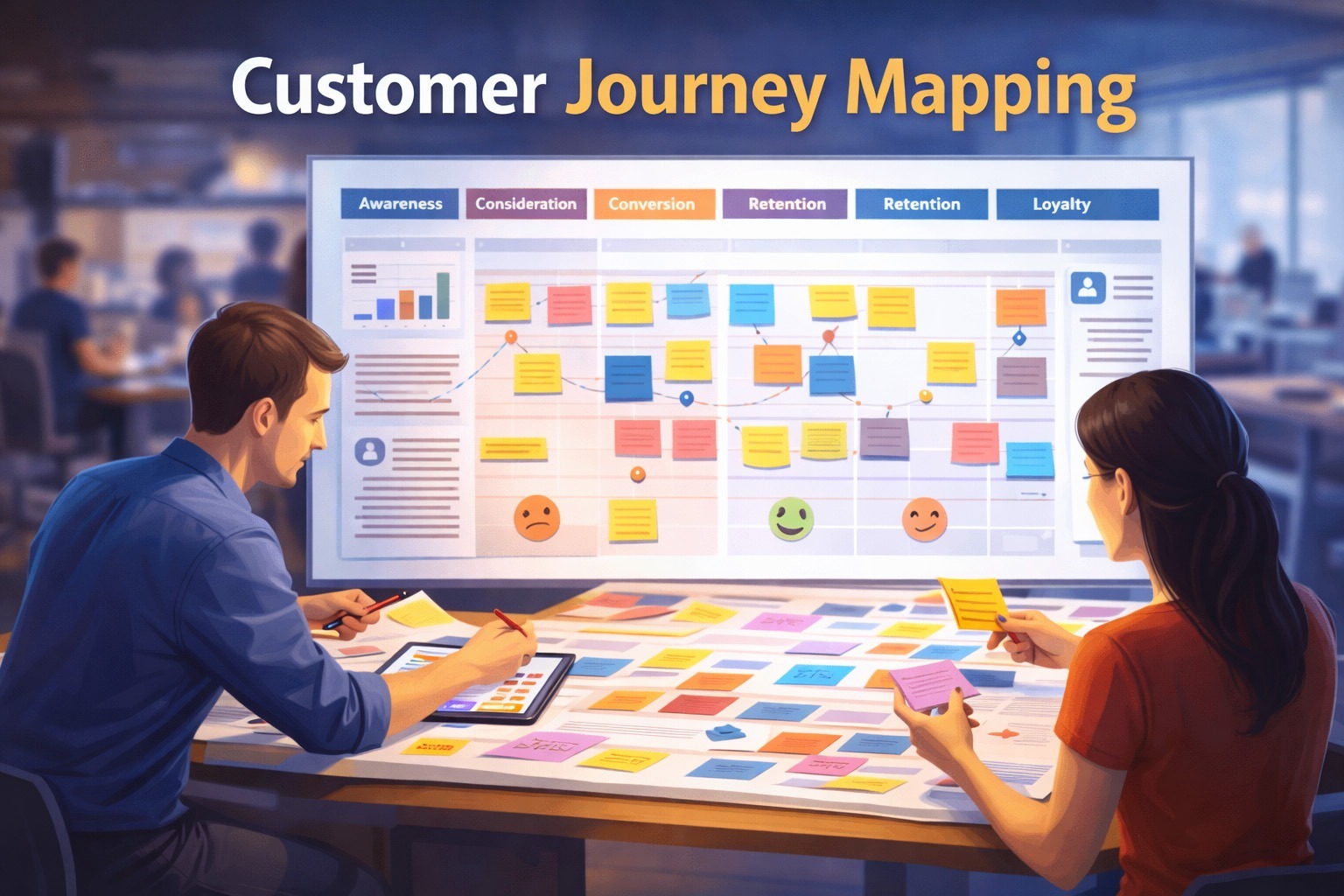 To optimize the customer journey at events in a targeted manner, many event organizers use so-called journey maps. These visualize all phases, touchpoints, goals, emotions and potential problems.
This type of mapping helps to break down internal silos. Marketing, event management, technology, security and service can see at a glance how their measures interact. At the same time, priorities can be set more clearly, for example when investing in technology, personnel or communication. Mapping is particularly effective when it not only shows idealized processes, but also depicts real experiences, for example on the basis of feedback, observations or data analyses.
Customer journey mapping translates the well-known principle of “walking in the customer’s shoes” into a structured method. The aim is to consistently view an event from the participants’ perspective and to make it clear how they experience the event across all contact points. Especially for events with many analog and digital interfaces, mapping helps to reduce complexity and make well-founded decisions.
A customer journey map is a visual representation of all relevant touchpoints. It not only shows what participants do, but also what they think and feel. For events, this means systematically mapping the path from initial perception to registration, arrival, participation and interaction through to follow-up.
Narrow or wide focus: two ways of journey mapping
There are different approaches to mapping the customer journey. A narrow focus looks specifically at individual sections, such as the registration process or on-site check-in. This is particularly useful when specific problems need to be solved, such as high drop-out rates during registration or long waiting times at the entrance.
A broader focus, on the other hand, maps the entire event journey, including all online and offline touchpoints before and after the event. This holistic perspective creates a comprehensive understanding of how individual measures interact and where experiences reinforce or hinder each other. This approach is particularly valuable for strategic event formats or recurring events.
Regardless of the scope, good customer journey maps are not based on assumptions, but on real data and real experiences.
Customer journey mapping in six steps
A structured approach has proven its worth in the event context:
- Define goal and scope: At the beginning, it is clearly defined which part of the event journey the journey map should depict and why. For example, the goal may be to improve the arrival situation or to make post-event communication more effective.
- Identify touchpoints: The next step is to collect all relevant touchpoints. For events, these range from social media ads, event websites and ticketing to check-in, sessions, catering and networking through to follow-up emails and feedback surveys.
- Collect data and insights: A robust journey map combines quantitative and qualitative data. This includes analytics figures, conversion data, feedback from surveys, on-site observations and feedback from service, technical or security teams.
- Build a mapping structure: The journey is usually depicted in a matrix. The phases or steps are arranged horizontally, while topics such as actions, questions, emotions, pain points and opportunities are arranged vertically. This creates a clear overall picture.
- Fill the journey with content: The individual fields are now supplemented with concrete findings. How do participants feel at check-in? Where do uncertainties arise? Which moments are perceived as particularly positive?
- Derive optimization potential: Finally, patterns, breaks and potential for improvement become visible. These form the basis for specific measures, from process adjustments and technical optimizations to changes in communication and service.
Why customer journey mapping is so effective for events
Customer journey mapping helps to move away from internal perspectives and consistently focus on the participants’ experience. At the same time, it creates a common basis for different disciplines, such as marketing, event management, technology, security and sales.
For events, this means, among other things:
- Friction points can be recognized and defused at an early stage
- Key emotional moments are planned in a targeted manner
- Responsibilities along the journey become clearer
- Decisions can be justified on the basis of data
It is important not to see journey mapping as a one-off exercise. Events, target groups and expectations change. Accordingly, the customer journey should also be regularly reviewed and further developed.
KPIs along the event customer journey
Success should be measured across all phases. While key figures such as conversion rates or registration figures are the focus in the pre-event area, operational and qualitative values such as check-in rates, session utilization or interaction rates are decisive during the event.
In the post-event phase, Net Promoter Score, feedback rates or re-registrations provide important indications of the overall impact. It is crucial not to view these key figures in isolation, but to interpret them in the context of the entire journey.
Customer journey as the key to successful events
The customer journey at events offers a holistic view of events from the participants’ perspective. It reveals where experiences are successful, where uncertainties arise and where there is potential for optimization. For event organizers, it is therefore much more than a theoretical model. It is a practical tool for strategically planning events, developing their quality and making them more successful in the long term.
Those who see events not just as a single appointment, but as a coherent journey, create the basis for stronger loyalty, greater satisfaction and lasting impact – regardless of whether it is a trade fair, a conference or a corporate event.