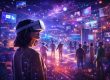

In Bangkok, film sets can switch from a cityscape to a virtual landscape within minutes. In Singapore, façades and public spaces become multimedia storytelling surfaces. Museums in Indonesia invite visitors to walk through digitally staged environments. Immersive experiences in Southeast Asia are now far more than a spectacular visual effect. They are developing into an important field of application for event technology, ProAV, film production, tourism and culture.
LED displays, extended reality and projection mapping are shaping this development in particular. Although the technologies differ in terms of structure and application, they pursue a similar goal: digital content should no longer appear on a single screen alone, but should involve the entire space.
What are immersive experiences?
 Immersive experiences are media-based experiences designed to draw visitors as deeply as possible into a real or virtual environment. Images, light, sound and, in some cases, movement, sensors or interaction are combined to create an overall spatial impression.
Examples include walk-in projection spaces, XR studios, digital art exhibitions, multimedia stage productions, interactive museums and large-scale façade installations.
However, immersion does not begin with the size of an LED wall or the number of projectors. What matters is the interplay between content, space, light, sound and control systems. Only when these elements are coordinated does a technical installation become a convincing experience.
Why is the market growing in Southeast Asia?
Southeast Asia offers favourable conditions for immersive applications. Rapidly growing cities, a digitally minded population, major tourism markets and a dynamic creative economy come together across the region.
The official tourism strategy of the ASEAN member states also reflects this development. The ASEAN Tourism Sectoral Plan 2026–2030 identifies digital transformation as one of the key areas of action for the further development of regional tourism.
At the same time, new venues, studios, museums, shopping centres and tourist attractions are emerging. They are all looking for formats that attract attention, encourage visitors to stay longer and allow spaces to be used flexibly.
Tourism needs new reasons to visit
Tourist destinations are competing not only for visitors, but also for their time and attention. Digital installations can retell historical content, create weather-independent attractions and bring existing locations to life after dark.
Projection mapping can, for example, be used to stage façades, monuments and public spaces temporarily. Museums can use immersive spaces to present collections or historical contexts in new ways. This also gives operators the option of changing content regularly without having to redesign the entire space structurally.
Social media also plays a role. Walk-in visual worlds, unusual light installations and digital stage designs create motifs that visitors photograph and share. The experience therefore also becomes a communication tool. The ASEAN Tourism Marketing Strategy 2026–2030 likewise highlights the importance of digital communication in positioning Southeast Asia as a travel destination.
Live events are produced for multiple channels
Concerts, festivals and corporate events are no longer aimed exclusively at the audience on site. Productions must also work for live streams, social media, television and subsequent video publication.
LED surfaces therefore fulfil several functions at once. They serve as stage design, information displays, light sources and camera backgrounds. Real-time graphics, media servers and camera tracking connect the physical stage with digital content.
Why LED is so important for immersive spaces
LED is one of the most visible growth technologies in the field of immersive experiences. The systems are bright, modular and suitable for both temporary productions and permanent installations.
One key advantage is their visibility in ambient light. While projections often require controlled lighting conditions, LED surfaces can also deliver high-contrast images in exhibition halls, shopping centres or open venues.
Modern LED systems are also no longer limited to rectangular video walls. Curved modules, LED floors, transparent surfaces, corner solutions and individually shaped structures increasingly make the display surface part of the stage and architecture.
Reusability is also important for rental and staging companies. The same modules can be configured differently depending on the project. This allows them to be used for concerts, trade fairs, corporate events or studio productions.
As pixel pitches continue to decrease, the range of applications expands further. Fine-pitch LED is suitable for spaces in which visitors or cameras are relatively close to the display. This also makes the technology attractive for broadcast studios, conference rooms, museums and premium brand installations.
How XR is changing production
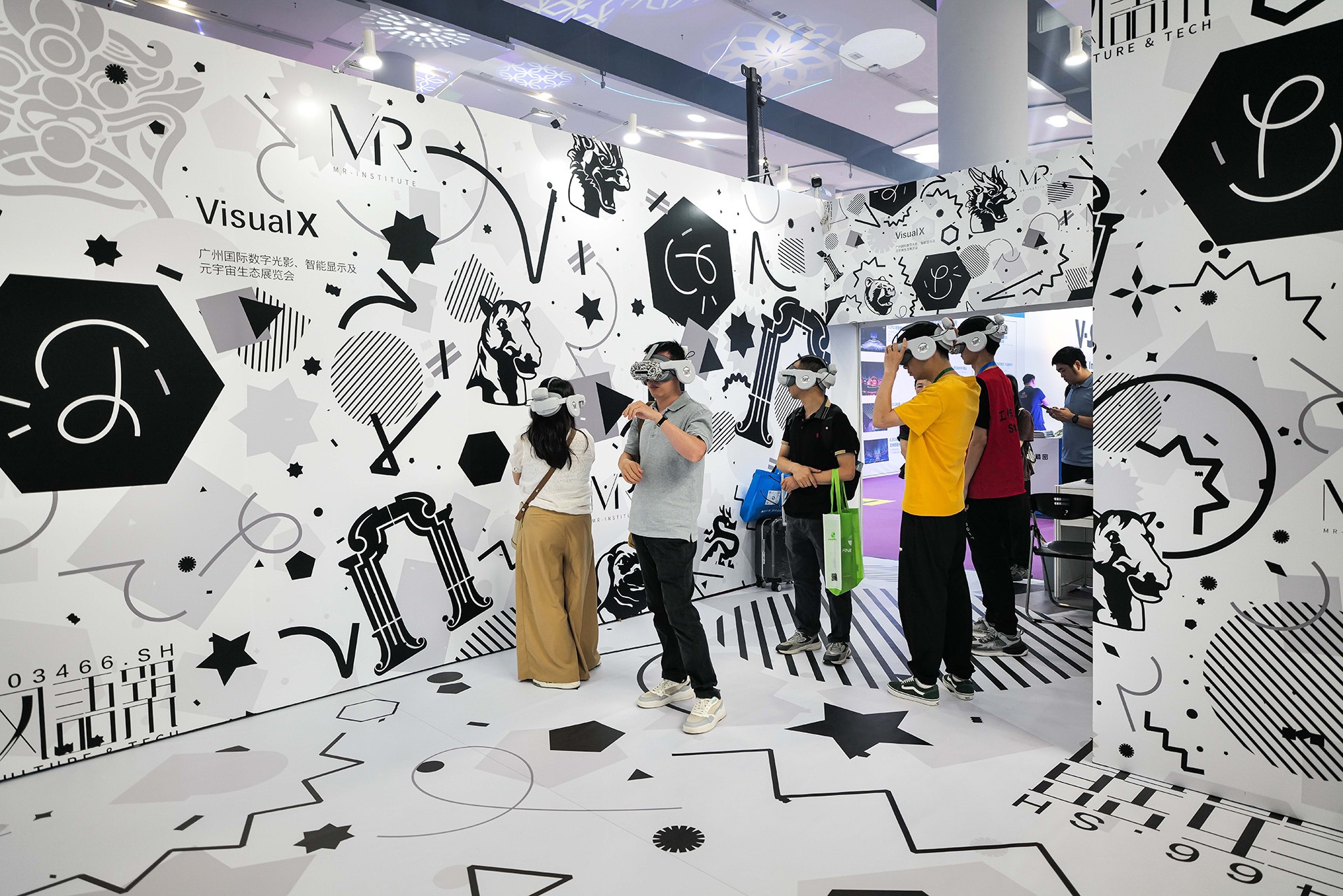 XR stands for extended reality and covers technologies that connect real and digital environments. In film, broadcast and events, XR often refers to productions using LED walls, camera tracking and real-time graphics. The tracking system detects the camera’s position and viewing direction. The virtual environment is then adjusted to the perspective in real time. This creates the impression of spatial depth in the camera image.
This opens up new possibilities for productions. Locations can be changed within a short period of time, weather and time of day remain controllable, and digital sets can be reused. At the same time, the LED surface creates real light reflections on people and objects.
Bangkok is expanding its virtual production capacity
Bangkok is developing into an important production location in this field. One example is Supreme Studio. The company installed a curved XR LED wall measuring around 37 metres wide and four metres high. A six-by-three-metre LED ceiling was added. The facility was designed specifically for film, advertising and video productions.
With Studio X Beyond, Bangkok also has another provider specialising in virtual production. Its services include LED volumes, real-time tracking, motion capture, a virtual art department and virtual location scouting. This shows that complete production workflows are increasingly developing around the LED surface itself.
Public-sector organisations are also supporting the connection between the creative economy and immersive technology. Thailand’s Creative Economy Agency operates the Virtual Media Lab, a platform designed to bring together digital media, virtual reality, art and technological development.
However, XR does not automatically make productions easier or cheaper. A substantial part of the work shifts to pre-production. Virtual sets must be designed early, tested technically and coordinated with camera work, lighting and movement sequences.
This calls for teams that can combine event technology, film production, games technology and 3D design.
Why projection mapping remains relevant
Despite the growth of LED, projection mapping retains its own strengths. While LED creates new display surfaces, mapping uses existing architecture and real objects.
The content is adapted so that it fits façades, sculptures, stage objects or interiors precisely. Windows, columns and building edges can become part of the animation. A façade can then appear to open, move or dissolve.
The technology is particularly attractive for light festivals, cultural events and city marketing. Large and irregular surfaces can be staged temporarily without permanently altering the building.
This approach is especially interesting in Southeast Asia. Many cities have striking architecture, cultural sites and a vibrant night-time economy. Mapping can activate public spaces after dark and create new tourism experiences.
Outdoor implementation nevertheless places high demands on planning. Ambient light, rain, humidity, lines of sight and possible obstructions must be taken into account from the outset. High temperatures and tropical weather conditions also affect the selection, cooling and protection of the technology.
Examples from Singapore, Thailand and Indonesia
Singapore regularly uses light art and projection in public spaces, museums and urban information environments. The technology is not used solely for entertainment. It also helps to communicate complex developments, collections or historical content spatially.
Bangkok brings together several relevant markets. The city has a large events, film and entertainment industry, numerous shopping centres and a significant tourism sector. The spectrum therefore ranges from XR studios and immersive art exhibitions to media-based leisure attractions in shopping centres.
Indonesia, in turn, offers considerable potential for cultural storytelling. Museums and exhibition venues can use digital spaces to retell landscapes, history and cultural traditions.
The technology should not be used merely as decoration. Such projects are particularly credible when local artists, historians, museums and technical service providers work together on the content.
Singapore: light art in public spaces
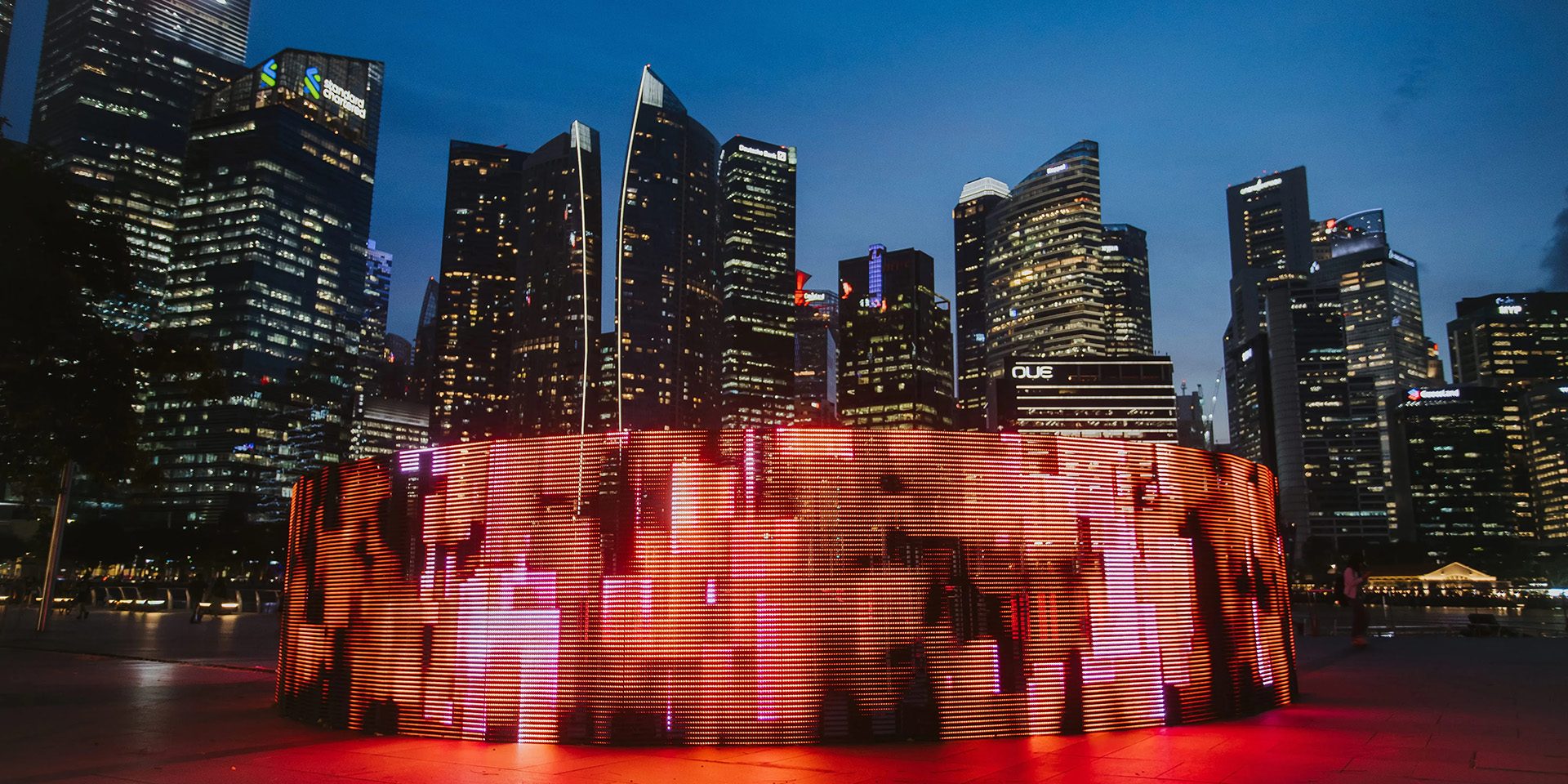
Singapore regularly uses light art to make public spaces newly accessible and engaging. This is especially evident at i Light Singapore 2026, which transformed Marina Bay and Raffles Place into a large-scale light art district from 5 to 28 June. Under the theme “Movement”, the festival presented 14 installations by 17 artists. More than ten of those involved came from Singapore or other parts of Asia.
Many of the works were not simply intended to be viewed, but responded to visitors’ movement and participation. The interactive installations included “Infinite Graffiti”, “WAVE”, “Where the Wildflowers Grow” and “Let’s Fish the Sun!”. Light, sound and digital elements changed in response to gestures, movement or other forms of interaction.
This made the public realm itself part of the installation. Marina Bay and Raffles Place served not merely as a backdrop, but as walk-in exhibition spaces where art, technology and urban life came together. Sustainability also remained an important part of the festival concept: the works used energy-efficient lighting and, in some cases, environmentally friendly materials to encourage visitors to think more consciously about the use of resources.
i Light Singapore 2026 therefore demonstrates how immersive light art can go beyond a purely decorative effect. The installations activate public spaces, involve visitors directly and create shared experiences at the intersection of art, technology and the urban environment.
Bangkok: immersive experiences between production and leisure
Bangkok brings together several relevant markets. The city has a large events, film and entertainment industry, numerous shopping centres and a significant tourism sector. The spectrum therefore ranges from professional XR studios to immersive leisure attractions aimed directly at visitors.
One example is Space & Time Cube+ in the Seacon Bangkae shopping centre. Covering more than 1,500 square metres, the attraction combines digital art with light, sound and interactive media. Visitors move through more than 20 differently designed areas, including LED tunnels, mirror rooms and digital scenarios. The offer is complemented by additional formats such as a Rail Cinema and a VR Experience. The operator also describes tunnels fitted with LED screens, in which content appears three-dimensional without the need for special glasses.
Space & Time Cube+ illustrates how the role of shopping centres is changing. Immersive technology is not used here merely as an addition to a conventional exhibition, but forms the core of a commercial leisure attraction. The individual rooms are also designed to be explored, photographed and shared on social media.
The project is therefore representative of a development that can be observed in many Southeast Asian cities: shopping centres are adding digital experiences to create new reasons to visit and increase dwell time. For the ProAV industry, this creates fields of application for LED displays, projection, media servers, lighting control, interactive systems and spatial audio.
While XR studios in Bangkok primarily target production companies, advertising clients and event organisers, Space & Time Cube+ is aimed directly at a broad public. Both applications are nevertheless based on a similar development: display surfaces, real-time technology and digital content are no longer considered in isolation, but are combined to create a walk-in overall experience.
Without sound, immersion remains incomplete
Immersive experiences are often perceived primarily through their visuals. Yet sound is equally important to the effect of a space.
Spatial audio can position sounds precisely within a room and provide an acoustic counterpart to movement. A voice, vehicle or animal can then be heard from the same direction in which it appears visually.
In museums, theme parks, XR productions and walk-in exhibitions in particular, spatial audio connects individual display surfaces into a coherent environment.
Sensors and interaction are also becoming increasingly important. Visitors can trigger content through movement, influence virtual objects or experience different sequences. The space therefore responds to the audience instead of merely playing a pre-produced sequence.
Immersive experiences are becoming a systems business
An immersive space rarely consists of a single product. Depending on the application, LED surfaces or projectors, media servers, real-time rendering, tracking, lighting control, network technology, sensors and sound systems all come together.
For systems integrators and production companies, this means that individual components increasingly have to be considered in context. A high-performance LED wall is not enough if the content, synchronisation, colour management or signal paths do not suit the application.
The choice of technology also depends on the individual project. LED is particularly suitable for bright environments, modular stages and studio productions. Projection mapping offers advantages for very large, irregular or historic surfaces. XR connects real productions with virtual spaces.
The technologies are often combined. A stage production can use LED, projection, real-time graphics, lighting and spatial audio at the same time.
Content becomes the decisive factor
As high-performance technology becomes increasingly available, the importance of content grows. Many immersive attractions use similar motifs: glowing tunnels, digital natural environments, space scenarios or seemingly endless mirror rooms.
In the long term, projects are therefore distinguished less by the size of the display surface than by their story, design and local relevance.
This is particularly true of museums, tourist attractions and cultural venues. In these settings, technology should support the content rather than overshadow it. A convincing immersive experience does not simply present images, but creates a comprehensible connection between space, subject and audience.
What role does Prolight + Sound Bangkok play?
Prolight + Sound Bangkok brings together many of the technologies and stakeholders required for immersive productions. The official product portfolio includes AR, VR, MR and XR, immersive technologies, mapping technology, projectors, interactive displays, LED technology and video walls.
The trade fair therefore reflects an environment in which the boundaries between event technology, ProAV, film production and digital entertainment are becoming increasingly blurred. For manufacturers, rental companies, studios, content producers and integrators, it is therefore more than a conventional product showcase.
Southeast Asia in particular demonstrates how broad the range of applications has become. Immersive technology is no longer confined to large concert stages. It is moving into museums, shopping centres, studios, hotels, tourist attractions and public spaces.
The next stage of development will therefore not be shaped by larger LED surfaces or brighter projectors alone. The decisive factor will be how intelligently image, sound, light, content and interaction are connected.
Immersion is therefore becoming less a question of individual devices and more a task for the entire system.
Header image: “Between Mountains and Seas, a dynamic light art installation by Peppercorns” at i Light Singapore 2026
Frequently asked questions about immersive experiences in Southeast Asia
Why are immersive experiences growing in Southeast Asia?
The main drivers include digitalisation, the expansion of the creative economy, large tourism and leisure markets, and growing demand for interactive and visually powerful experiences.
What is the difference between XR and projection mapping?
XR connects real people or objects with virtual environments and often uses LED walls, tracking and real-time graphics. Projection mapping projects adapted content onto real buildings, objects or spatial surfaces.
Is LED replacing projection?
No. LED is particularly suitable for bright environments, studios and modular stages. Projection mapping is especially useful for very large, irregular or historic surfaces.
Which industries use immersive technologies?
The main fields of application include live events, film and broadcast, museums, tourism, retail, corporate events, theme parks and digital art.
What technology is required for immersive experiences?
Depending on the application, LED or projection, media servers, tracking, real-time rendering, audio, lighting control, sensors and network technology are combined.