


Artificial intelligence has long since moved beyond simply generating music at the push of a button. In professional audio production, it is increasingly taking on tasks that previously required a great deal of time and meticulous manual work. Modern systems can clean up voice recordings, break down finished songs into their individual components, identify technical issues in a mix, or prepare mastering suggestions.
As a result, AI is transforming nearly every stage of the production process: from the initial idea through recording and post-production to release. The goal is not necessarily to replace producers, musicians, or sound engineers. Of particular interest are applications that streamline repetitive processes, thereby creating more room for creative decisions.
But what are these systems already capable of? What are their limitations? And why is AI audio particularly relevant for the growing media, music and entertainment markets in Asia?
What does AI mean in audio production?
Broadly speaking, a distinction can be made between assistive and generative AI.
Assistive AI analyses existing audio material and assists with its editing. Among other things, it can:
- Reduce background noise
- Separating vocals and instruments
- Suggest settings for equalisers or compressors
- Analysing loudness, dynamics and frequency distribution
The source material continues to come from musicians, voice-over artists or production teams.
Generative AI, on the other hand, creates new music, voices or sound effects based on text inputs, reference files or other specifications. A prompt can, for example, describe the mood, tempo, instrumentation and dramatic structure.
In professional workflows, both approaches are often combined. A musical sketch may be created generatively, expanded upon by musicians, edited with the aid of AI, and then mixed manually. This makes production processes more flexible, but also more complex.
 How is AI changing recording and audio editing?
A clean recording remains the best foundation for a high-quality production. However, interviews, podcasts, live recordings and outdoor recordings are not always made under ideal conditions. Street noise, air conditioning, room reverberation or varying microphone distances can impair intelligibility.
AI-powered restoration tools analyse such images and attempt to distinguish the desired signals from interfering elements. For example, they can:
- Reducing noise and hum
- Removing clicking and background noises
- Highlight language
- Reduce room reverberation
- Separate dialogue, music and ambient noise
This is particularly beneficial for broadcast, podcast production, film sound, documentaries and corporate communications. A passage from an interview that is difficult to understand can, in some cases, be salvaged without having to re-record it.
However, human oversight remains necessary. If the algorithm intervenes too heavily, voices may sound artificial, consonants may disappear, or characteristic spatial elements may be lost. Audio restoration therefore remains a balancing act between technical precision and natural sound.
What is AI-based stem separation?
In stem separation, an audio file that has already been mixed is broken down into its individual components. Depending on the system, it is possible, for example, to isolate vocals, drums, bass or other instruments.
The stems generated can then be edited in the same way as standard audio tracks. Typical applications include:
- Remixes and mash-ups
- Instrumental and karaoke versions
- Post-production of live recordings
- Restoration of older photographs
- Extraction of individual samples
- Adapting music to film and advertising formats
However, it is not always possible to achieve a completely clean separation. If instruments overlap significantly in the frequency spectrum, or if a large number of effects have been applied, crosstalk and audible artefacts may occur. Stem separation makes existing material accessible again, but does not replace the original multitrack recording.
How does AI help with mixing?
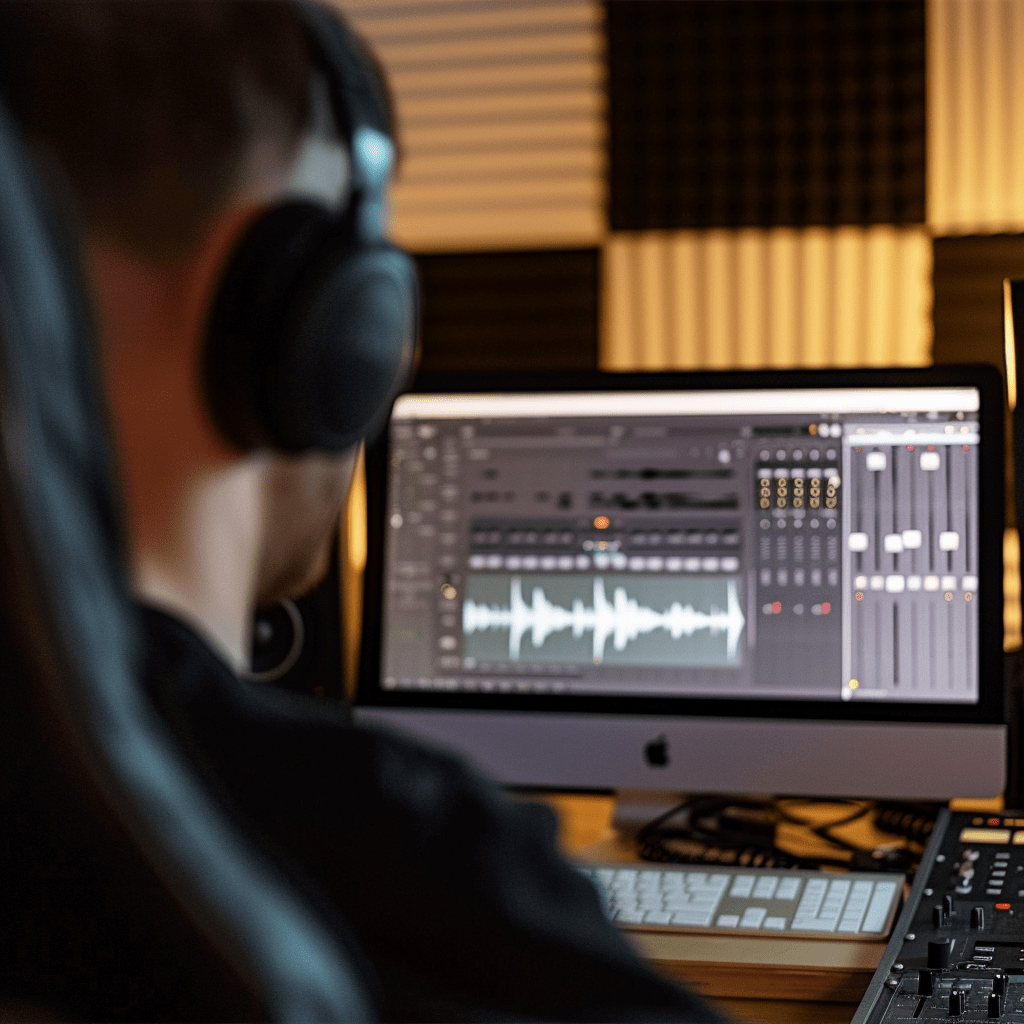
During mixing, levels, frequencies, dynamics, stereo width and spatiality all influence one another. AI-powered mixing assistants analyse the material and prepare a technical starting point. In doing so, they can identify strong resonances, unfavourable frequency overlaps, large differences in volume, unbalanced dynamics or conflicts between vocals and instruments.
They then suggest settings for equalisers, compressors or other processors. The main advantage lies in the preparation. Rather than analysing each track from scratch, sound engineers are given an initial assessment which they can build on.
However, a compelling mix is not achieved through technical balance alone. Which voice takes centre stage, how close an instrument should sound, or how the energy of a song develops, remains a creative decision. AI can identify problems, but it does not automatically understand the artistic intention.
 What can automated mastering achieve?
Mastering is the final stage of sonic and technical processing prior to release. During this process, the frequency balance, dynamics, stereo image and loudness are checked. AI-powered mastering assistants analyse a mix and generate suggestions for a suitable processing chain.
Among other things, they take the following into account:
- Target volume
- Frequency distribution
- Dynamic range
- Stereo imaging
- Transients
- technical requirements of various platforms
Automated Mastering is particularly suitable for demos, podcasts, social media content, preview versions or series productions involving large numbers of similar files.
When it comes to complex album productions, human mastering still has the edge. It’s not just about technical parameters, but also about transitions, dramatic structure and an overarching sonic aesthetic.
How do transcription and text-based editing make production easier?
Speech recognition is transforming editorial audio workflows in particular. Interviews, podcasts and recordings of conversations can be automatically transcribed and searched based on their content. In some applications, the audio can be edited directly via the text.
This makes it possible to find statements more quickly, review long interviews more efficiently and remove slips of the tongue or pauses in a targeted manner. It is also easier to identify changes in speakers, whilst chapter markers, subtitles and translations can be prepared more quickly.
This is particularly relevant for international productions. However, proper names, regional accents and technical terms should still be checked by an editor.
What possibilities do synthetic voices offer?
AI-generated voices are used in advertising, audiobooks, podcasts, games, e-learning and audiovisual media. They can read out text in different languages, vary the pace and intonation, and allow for text corrections to be made after the fact.
Voice cloning involves digitally replicating a real voice using voice recordings. Whilst this can simplify production, it directly affects personality rights and exploitation rights. Before use, therefore, the speakers’ express consent, clearly defined areas of use, fixed durations and transparent remuneration should be agreed. Equally important are protection against unauthorised disclosure and clear labelling of synthetic content.
Technically feasible applications are not automatically permissible from a legal or ethical point of view.
 How are music and sound effects generated using AI?
Generative audio systems can create music, atmospheric sounds or individual sounds from text descriptions. Users specify, for example, the genre, mood, tempo or instrumentation.
Typical applications include:
- musical sketches
- temporary music for film and video
- Background music
- Sound effects for games and XR
- Atmospheres for events and installations
- Options for advertising and social media
For producers and sound designers, such systems are particularly useful for brainstorming. The generated material can then be edited, layered or combined with real recordings.
So far, these systems have only offered limited creative control. There is often a lack of long-term musical development, precise transitions or a deliberate dramatic structure. Furthermore, usage rights and training data must be checked before any commercial use.
What are the limitations of AI in audio production?
AI-powered audio tools can significantly speed up work processes, but they do not automatically produce a convincing result. Technical shortcomings can arise, particularly with complex mixes, challenging source material or unusual sonic aesthetics.
Typical problems include, for example:
- voices that sound metallic or artificial
- unstable space mappings
- smeared transients
- Crosstalk between separate tracks
- excessive dynamic processing
- Misinterpretations of unusual soundscapes
- Artifacts following noise reduction or voice separation
Such changes are particularly noticeable in speech, singing or acoustic instruments. A signal may sound technically cleaner, but at the same time lose warmth, expression or musical tension. An algorithm may treat deliberately chosen sonic decisions as errors, thereby altering the emotional impact.
That is why professional oversight remains crucial. AI can prepare, refine and speed up the process. However, the final assessment should be carried out by experienced sound engineers, producers or editors.
With cloud-based services, data protection is an additional consideration. Before uploading sensitive files, companies should check where the data is stored, who has access to it, whether it will be used for training purposes, and whether it can be completely deleted. Clear internal rules are particularly necessary for unpublished, confidential or copyright-protected material.
Will AI replace producers and sound engineers?
AI is changing job roles, but it does not render human expertise redundant. It primarily takes on tasks such as analysis, sorting and routine technical work. As a result, the focus is shifting more towards selection, evaluation and creative management.
Among other things, the following will become more important:
- critical listening
- musical understanding
- Detecting AI artefacts
- Control of automated systems
- Knowledge of data protection and usage rights
- Documentation of hybrid workflows
In future, producers and sound engineers will play a greater role in shaping the interaction between different systems. They will decide which tasks are automated and which are deliberately carried out manually.
What role does AI audio play at Prolight + Sound Bangkok?
AI is transforming the professional audio industry not only technically, but also structurally. New tools are influencing workflows, job roles and collaboration between manufacturers, producers, sound engineers and content creators. For the Asian market in particular, this raises the question of how international technologies can be integrated with regional languages, musical traditions and production conditions.
From 30 September to 2 October 2026, Prolight + Sound Bangkok will take place at the Bangkok International Trade & Exhibition Centre (BITEC), serving as a key meeting place for the entertainment, events and ProAV sectors in South-East Asia. The trade fair offers the opportunity to discover the latest developments, experience new solutions in action and discuss the future of professional audio production.