

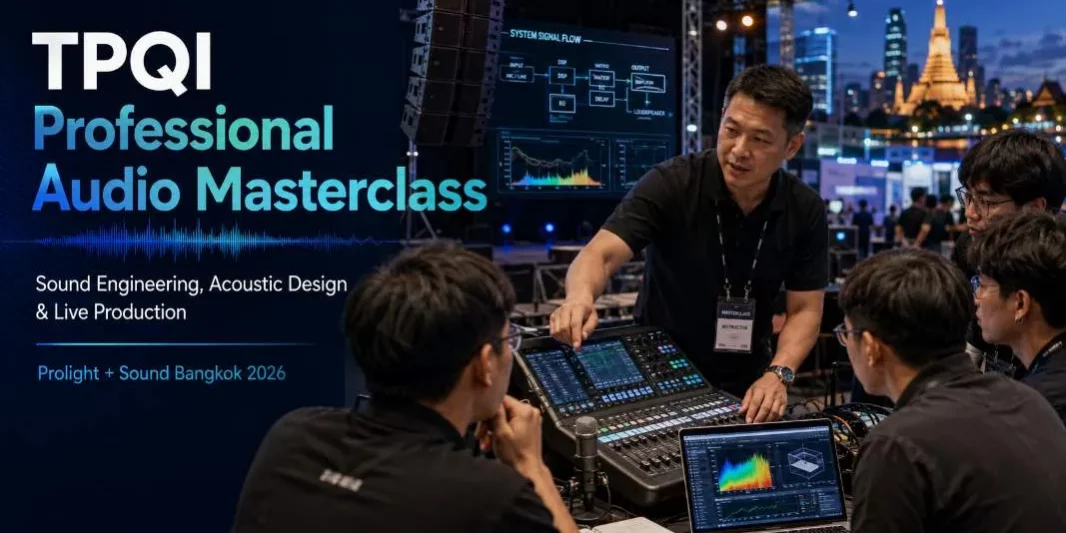
Professional audio technology demands far more than knowledge of mixing consoles, loudspeakers or microphones. Anyone planning sound reinforcement systems, managing live productions or setting up complex audio systems must understand technical relationships, coordinate systems effectively and work reliably even under demanding conditions. Describing, teaching and developing such professional skills systematically is one of the tasks of the Thailand Professional Qualification Institute (TPQI).
At Prolight + Sound Bangkok 2026, the institute will present a TPQI Professional Audio Masterclass. The three-day intensive programme will focus on sound engineering, acoustic design and live production, directly linking one of the key subject areas of Prolight + Sound Bangkok with professional qualification and skills development.
What is the Thailand Professional Qualification Institute?
The Thailand Professional Qualification Institute, or TPQI for short, is a public organisation in Thailand concerned with professional qualifications and occupational competency standards. Its work centres on a fundamental question: What knowledge and skills does a person actually need in order to carry out a particular professional activity to a professional standard? The focus therefore goes beyond traditional educational qualifications. After all, professional competence is not developed solely at universities, vocational schools or other educational institutions.
Professionals acquire a significant proportion of their knowledge through practical work, further training and professional experience. This is precisely where TPQI’s Professional Qualification System comes in. Knowledge, skills, abilities and professional experience are described and assessed on the basis of defined standards. The aim is to create a stronger connection between the requirements of the workplace and professional qualification.
What are TPQI’s responsibilities?
 One of the institute’s core tasks is the development and further refinement of Occupational Standards, which define the competencies and activities required for specific roles and professional fields. Their scope extends far beyond technical professions. TPQI maintains standards and qualification areas for fields including electrical and electronics professions, robotics and automation, construction, healthcare, tourism and hospitality, aviation, sport, retail and the entertainment industry. This creates an infrastructure through which professional skills can be systematically described and developed. TPQI works with companies, educational institutions, training organisations and both public and private-sector institutions.
How do Professional Qualifications and Occupational Standards work?
Central to the system is the concept of competence. For TPQI, professional competence is not simply a matter of theoretical knowledge. What matters is whether a person can successfully apply their knowledge, skills, personal capabilities and experience in a specific professional situation. The institute’s Professional Qualifications Framework defines different levels of competence. These take into account factors including:
- the scope and complexity of an activity
- the knowledge and skills required
- responsibility within the work process
- expected work outcomes
- independent working
- the ability to deal with more complex tasks
- innovation and problem-solving skills
This approach is particularly relevant to technical professions. In professional audio technology, for example, it is not enough simply to understand individual technical terms. Professionals must be able to assess how components interact within an overall system and how technical decisions affect the outcome of a production.
Practical experience rather than theory alone
TPQI’s competency-based approach explicitly recognises that professional expertise can be developed in different ways. Practical work experience is just as important as structured education and training. This is particularly relevant in the events and entertainment industry, where many professional workflows can only be learned to a limited extent from textbooks. How does a sound reinforcement system behave in a particular room? How should loudspeaker systems be positioned? How can problems in the signal path be systematically identified?
What changes are required when the technical conditions alter during a production? Situations like these demand not only basic knowledge, but above all experience, a structured approach and the ability to assess technical relationships quickly. It is precisely this combination of knowledge and practical capability that lies at the heart of competency-based qualification models.
TPQI also focuses on digital training
In addition to competency standards and qualification systems, the institute runs its own e-training programme. These digital training courses are based on Occupational Standards and are designed to enable professionals to develop their skills independently of a particular learning location. TPQI now offers numerous e-training courses across a wide range of professional fields. These may include digital learning content, pre- and post-tests and electronic certificates of participation. In this way, the institute combines standards, skills development and professional training. The Professional Audio Masterclass at Prolight + Sound Bangkok now brings this approach into a face-to-face format within an international industry platform.
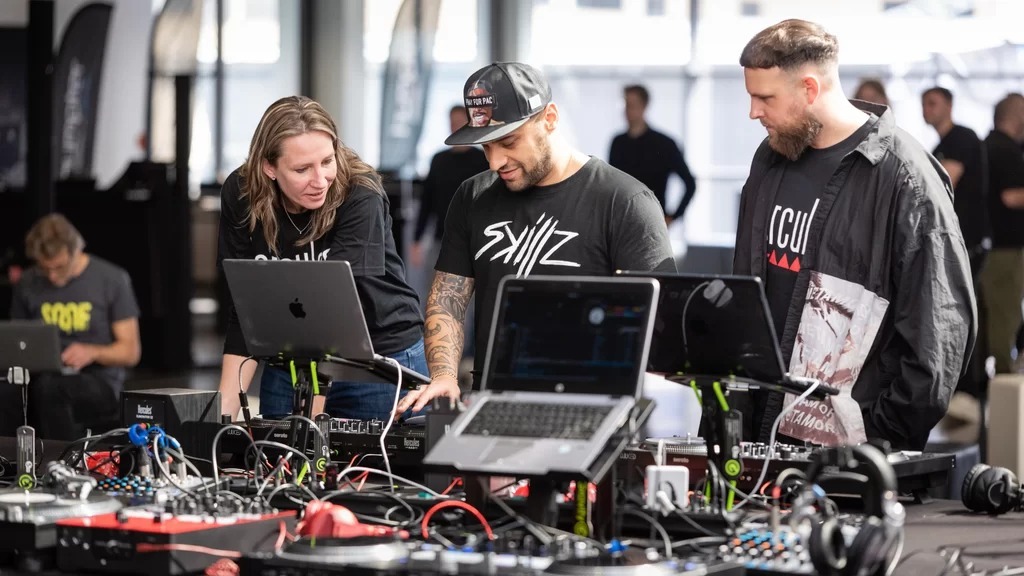
Knowledge transfer and entertainment have always been part of the Prolight + Sound brand concept. | Photo: Mathias Kutt
What does professional competence mean in professional audio technology?
Few fields demonstrate the importance of practical competence more clearly than professional live audio. Effective sound reinforcement depends on the interaction of numerous factors. These include signal sources and signal paths, mixing consoles, amplification, loudspeaker systems, digital signal processing and the acoustic characteristics of a venue. Professionals therefore need to understand individual parameters while also keeping the overall system in view. Key technical fundamentals include:
- levels and gain structures
- impedance
- frequencies and frequency ranges
- phase
- signal routing
- loudspeaker positioning
- time alignment of loudspeaker systems
- phase alignment
- room acoustics
- system control
Live production adds another challenge: many decisions must be made under real production conditions. Before an event, the system has to be planned and set up. This is followed, for example, by line checks, technical soundchecks and system adjustments. During a production, technicians must also be able to respond to changing conditions. Professional audio technology therefore combines planning, technical analysis and practical problem-solving.
TPQI Professional Audio Masterclass at Prolight + Sound Bangkok
This is precisely where the announced TPQI Professional Audio Masterclass comes in. The Thailand Professional Qualification Institute will run a three-day programme as part of Prolight + Sound Bangkok. The focus will be on three major areas: Sound Engineering, Acoustic Design and Live Production. According to the information available so far, the masterclass is intended to cover both fundamentals and practice-oriented specialist knowledge. Planned topics include the design of professional sound reinforcement systems, signal routing, room acoustics and system tuning.
The programme will also address workflows directly related to live production. These include preparing front-of-house and monitor consoles, carrying out technical soundchecks and dealing with more complex production situations. The masterclass therefore goes beyond presenting individual technologies. Its emphasis is on developing a better understanding of technical relationships and professional workflows.
From individual devices to the complete audio system
This approach is particularly relevant to modern audio production. Professional sound reinforcement now consists of highly interconnected systems made up of many different components. A single high-quality device does not guarantee a good result. What matters is how everything works together. A loudspeaker system must suit the venue. Signal paths need to be set up correctly. Levels must be matched. Timing and phase relationships can have a significant impact on the result. At the same time, front of house, monitoring and other production areas must work together reliably.
The work of professional audio specialists is therefore increasingly shifting away from operating individual components towards understanding complete systems and workflows. A masterclass that combines fundamental knowledge with these practical relationships therefore addresses an important industry need.
Who is the Professional Audio Masterclass aimed at?
The programme is particularly aimed at professionals who already work with professional audio technology or who want to deepen their knowledge in this field. This includes, for example:
- audio technicians
- live sound engineers
- system technicians and system designers
- production managers
- event technicians
- technical staff working at venues
- young professionals in the audio and events industry
Different aspects of the programme may be relevant depending on participants’ previous experience. For young professionals, the masterclass offers an opportunity to place technical fundamentals within a broader context. More experienced participants, meanwhile, may benefit particularly from the focus on professional workflows, system planning and more complex production scenarios.
Three days of knowledge transfer at the heart of the industry
Holding this kind of training format at a trade fair offers an additional advantage. Participants are not dealing with theoretical models in isolation, but are simultaneously surrounded by an environment in which current solutions for professional audio, AV and event technology are being presented. From 30 September to 2 October 2026, Prolight + Sound Bangkok will bring together manufacturers, distributors, integrators, planners and users from the entertainment, events and ProAV industries at the Bangkok International Trade & Exhibition Centre, or BITEC.
Alongside professional audio technology, the exhibition will cover areas including lighting technology, stage and event technology, LED and display solutions, AV systems integration, musical instruments and studio equipment. This makes it possible to connect specialist knowledge directly with technological developments.
Qualifications as a factor in the growing ASEAN events industry
The importance of such programmes extends beyond the event itself. Southeast Asia is developing into an increasingly significant market for live entertainment, professional AV technology and event technology. New venues, festivals, entertainment concepts, hotels, convention centres and immersive experiences are not only increasing demand for technology. They are also creating a growing need for skilled professionals who can plan, install and operate complex systems.
Technical innovation alone is not enough. A growing industry also needs systematic education and training, transparent competency standards and opportunities for professional development. TPQI’s work therefore addresses a key question for the future of the industry: How can technological development and professional competence be ensured to grow together?
Further programme details to follow
The exact schedule for the TPQI Professional Audio Masterclass has not yet been published in full. Further information on individual sessions, speakers, times and participation requirements is expected to be announced at a later date. It has also not yet been confirmed whether the three-day masterclass will include a formal examination, certificate or official TPQI Professional Qualification. Anyone interested should therefore follow further announcements concerning Prolight + Sound Bangkok and its supporting programme.
What is already clear is that the TPQI Professional Audio Masterclass will give professional development its own dedicated place within the new industry platform in Bangkok. In a technically demanding field such as professional audio, this transfer of knowledge is crucial. Modern systems are becoming more powerful and more complex, but their full potential can only be realised when people have the necessary expertise to plan, set up and operate them professionally.
The Prolight + Sound Bangkok 2026 will take place from 30 September to 2 October 2026 at the Bangkok International Trade & Exhibition Centre (BITEC).