
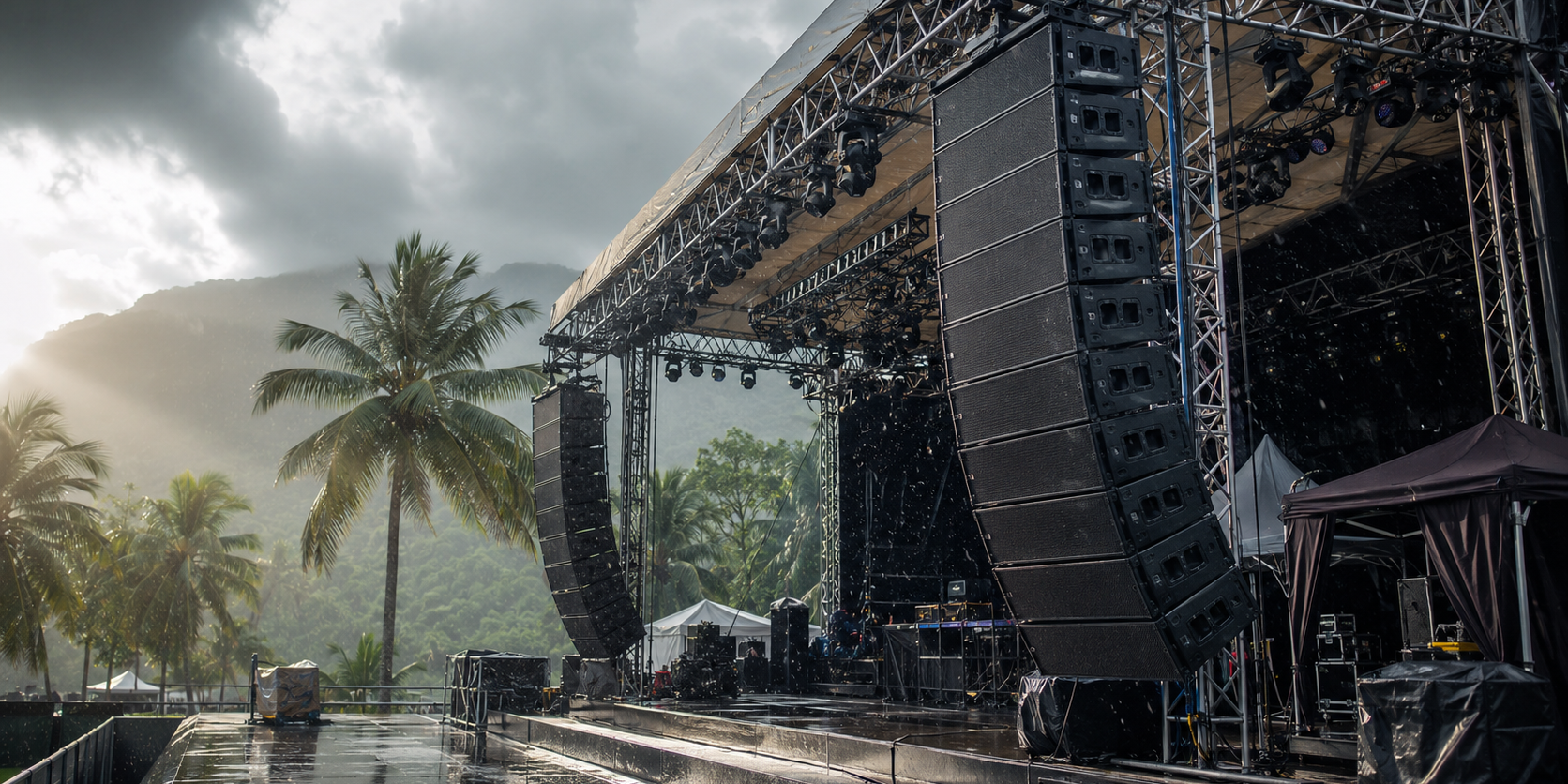
Heavy, warm air hangs over the stage. Just minutes before the concert, dark clouds gather and the rain begins. Water runs across trusses and cables, humidity rises, and yet loudspeakers, amplifiers and connections still need to operate reliably. What may be an exception in temperate regions is part of everyday life at many outdoor events in Southeast Asia.
Outdoor audio in tropical climates is therefore not simply a matter of choosing one weather-resistant loudspeaker. What matters is how the enclosure, connections, cables, mounting hardware, amplifiers, power supply and maintenance work together. Only when all components are matched to the environment can a system remain safe, reliable and powerful under demanding conditions.
The topic also plays an important role at Prolight + Sound Bangkok. Outdoor audio demonstrations featuring modern line array systems are among the programme highlights announced for the premiere, which will take place at the Bangkok International Trade & Exhibition Centre from 30 September to 2 October 2026.
The key points at a glance
Outdoor loudspeakers for tropical climates should not be selected on the basis of their IP rating alone. Corrosion-resistant materials, sealed connections, UV-resistant enclosures, suitable cables, secure mounting and a consistent maintenance strategy are just as important.
IP54 may be sufficient for protected outdoor areas. Where installations are permanently exposed or subject to regular heavy rain, IP55 is often the more robust starting point. IP56 offers additional protection against powerful water jets and can be particularly relevant for water parks, sports facilities and other highly exposed locations.
However, the stated protection rating only applies under the conditions defined by the manufacturer. Mounting angle, connector type and suitable connection cables can determine whether the specified level of protection is actually achieved.
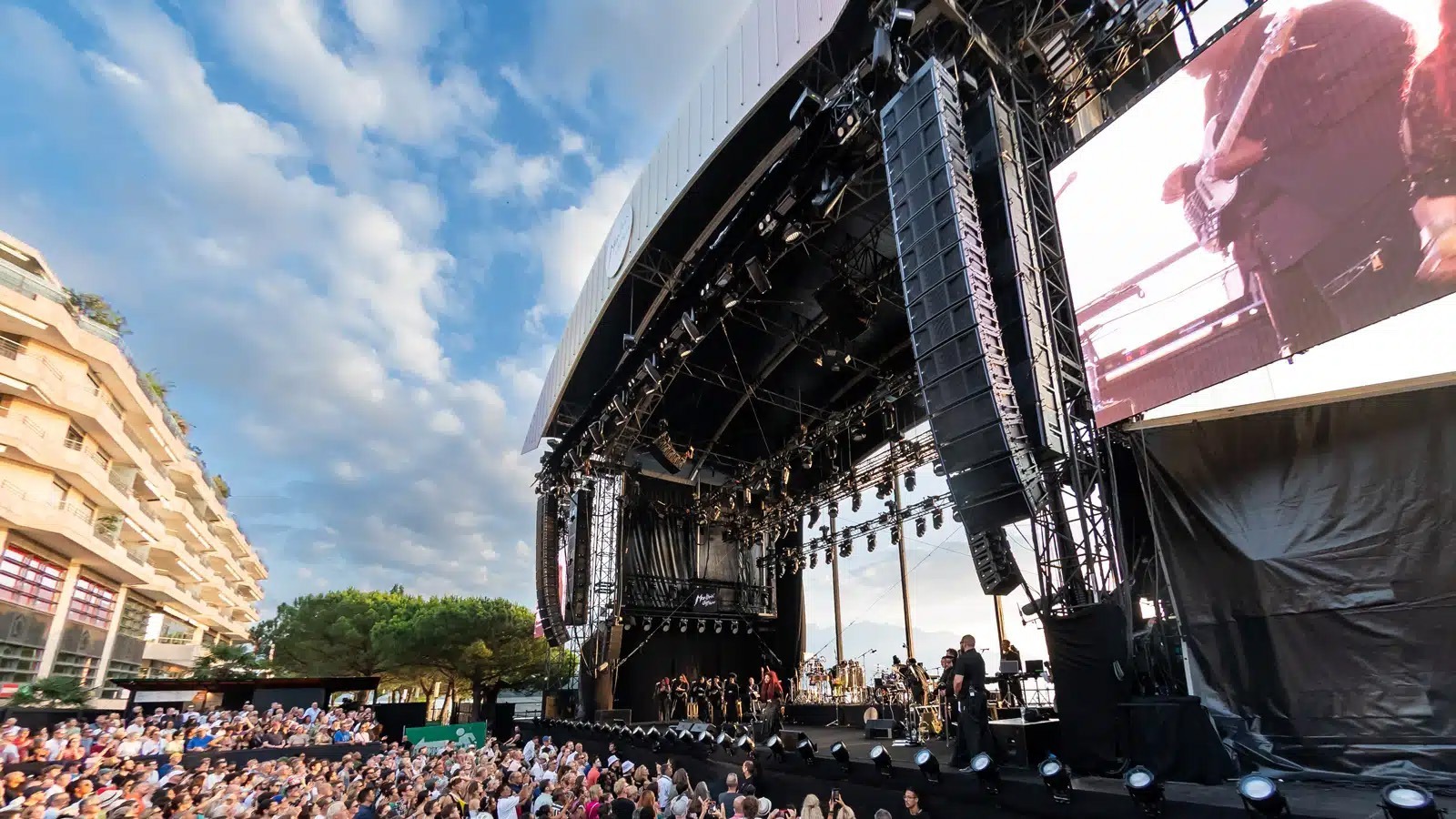
Meyer Sound delivers world-class sound for the 2025 Montreux Jazz Festival (Image: Meyer Sound / Marc Ducrest)
Why is outdoor audio in tropical climates particularly demanding?
A tropical climate does not simply mean frequent rain. Professional audio technology is exposed to several forms of stress at the same time, including heat, heavy rain, intense UV radiation and salt-laden air. This creates a particularly demanding environment. A loudspeaker not only needs to sound good and deliver the required sound pressure level. It must also continue to operate reliably when moisture can penetrate every weak point and materials are subjected to climatic stress for months or years.
Heavy rain and water driven in from the side
A stage roof does not protect loudspeakers and technical equipment completely. Wind can drive rain underneath the structure from the side. Water can also run along cables and reach connections, distribution units or amplifiers.
Particularly problematic are:
- unprotected connection panels,
- open connectors,
- unsuitable cable glands,
- horizontal cable runs without drip loops,
- equipment racks positioned directly on the ground,
- standing water beneath stages or grandstands.
Outdoor systems therefore require more than protection from above. Installation position, connector orientation and water drainage must also form part of the planning process.
Persistently high humidity
In the long term, high humidity can cause greater damage than a single rain shower. It encourages corrosion and can affect contacts, screws, grilles, diaphragms, coatings and electronic components.
Condensation is a particular concern. When cold equipment is moved from an air-conditioned storage area into warm, humid outdoor air, moisture can form both on and inside the equipment. Devices should therefore be allowed to acclimatise to the ambient temperature before being switched on.
High temperatures
Direct sunlight can heat dark loudspeaker enclosures, amplifier racks and cables significantly. High temperatures can cause electronic devices to reduce their output or shut down as a protective measure.
With active loudspeakers, the amplifier electronics are housed directly inside the enclosure. In passive systems, by contrast, the amplifiers can be installed in a protected and, where necessary, air-conditioned technical room.
The decision between active and passive systems should therefore not be based on sound and handling alone. Climatic conditions and maintenance access also need to be considered.
UV radiation
UV radiation causes plastics, paint finishes, seals and cable sheathing to age. Materials may fade, become brittle or lose their protective properties.
For permanent installations, preference should therefore be given to components for which the manufacturer explicitly provides information on UV resistance or relevant environmental testing.
Salt and corrosion
Coastal regions, islands, cruise ships and resorts located directly by the sea impose particularly demanding requirements. Salt greatly accelerates the corrosion of metal parts and electrical contacts.
A high IP rating alone does not indicate how well a loudspeaker is protected against salt-laden air. Additional specifications are therefore essential for coastal locations. These include documented salt spray testing, stainless-steel brackets, corrosion-protected grilles, treated screws and flying hardware. Sealed cable glands and, where appropriate, special marine or seawater-resistant versions are equally important.
What do IP54, IP55 and IP56 mean for loudspeakers?
The IP rating describes how effectively an enclosure is protected against the ingress of solid foreign objects and water. The first digit refers to dust and contact protection, while the second refers to water.
IP54 protects an enclosure against harmful quantities of dust and against splashing water. This may be sufficient for covered terraces, protected outdoor restaurants, temporary events or loudspeakers installed beneath sufficiently deep canopies. For permanently exposed installations in monsoon regions, however, IP54 is generally not a particularly robust basis for planning.
IP55 additionally provides protection against water jets and is widely used for professional installation and touring loudspeakers. Suitable applications include open-air theatres, stadiums, grandstands, festival stages, theme parks and hotel outdoor areas. However, an IP55 loudspeaker is not waterproof; flooding or immersion is not permitted.
IP56 also protects against more powerful water jets and can therefore be of particular interest for highly exposed areas such as water parks, swimming pools, sports facilities, race tracks, open squares or locations with frequent heavy rain. The manufacturer’s mounting instructions remain decisive. The JBL AWC82, for example, only achieves IP56 when tilted downwards by at least five degrees. JBL also cites tests covering humidity, salt spray, temperature and UV exposure.
Why the IP rating alone is not enough
A loudspeaker may be rated IP55 while its cables, connectors or rigging components are far less well protected. The entire system therefore needs to be assessed. Planners should establish whether the stated protection rating applies only to the enclosure or also when the system is connected, which connectors are required and whether unused ports need to be sealed. The specified mounting angle, the corrosion resistance of brackets and screws, and whether the loudspeaker may remain permanently exposed or still requires additional shelter are equally important.
Audio manufacturers also offer solutions for the complete system. With the Meyer Sound PANTHER, IP55 protection is complemented by cables with suitable Neutrik TOP connectors, eliminating the need for rain hoods. The system combines a weather-resistant enclosure with sealed power, signal and network connections. This demonstrates that even a single unsuitable connector can compromise the weather protection of the entire system.
Active or passive loudspeakers for tropical outdoor areas?
Both system concepts can be suitable for outdoor audio in tropical climates, but they place different demands on planning, weather protection and maintenance.
In active loudspeakers, the amplifier and signal processing are integrated directly into the enclosure. This creates a matched system, reduces the need for central amplifier racks and often makes monitoring and rapid deployment easier. At the same time, power, signal and, where applicable, network connections must be routed to every loudspeaker or array. This places more electronic components in the exposed outdoor area and increases the requirements for connectors, cables and enclosure sealing. Active systems are therefore particularly convincing when the manufacturer has designed the loudspeaker, electronics and connections as one continuous weather-protection concept.
Passive loudspeakers, by contrast, are powered by external amplifiers. The sensitive electronics can therefore be housed in a protected or air-conditioned technical room. This simplifies maintenance and reduces the number of active components at the exposed mounting location. The trade-offs are longer loudspeaker cable runs, potential transmission losses and greater planning complexity in large systems. For stadiums, theme parks, hotels and permanent outdoor installations, however, passive loudspeakers with weather-resistant enclosures and centrally installed amplifiers can offer an especially robust solution.
| Criterion | Active loudspeakers | Passive loudspeakers |
| Electronics outdoors | The amplifier and signal processing are located directly inside the loudspeaker and are exposed to heat, humidity and temperature fluctuations. | The amplifiers can be installed in a dry or air-conditioned technical room. |
| Protection of connections | Power, signal and network connections must be fully weather-protected. | At the loudspeaker, protection is mainly required for loudspeaker cables, connection panels and cable glands. |
| Performance in heat | Direct sunlight can place significant thermal stress on the integrated electronics. | The sensitive electronics can be protected from heat more easily. |
| Maintenance in high humidity | Repairs or inspections often need to be carried out directly at the mounting location. | Amplifiers and processing equipment are centrally located and generally easier to access and maintain. |
| Cabling | Shorter loudspeaker cable runs, but additional power and network connections to each system. | Longer loudspeaker cable runs and possible transmission losses over greater distances. |
| Mobile open-air productions | Well suited where weather protection and connections are designed as one integrated system. | Greater effort due to additional amplifier racks and loudspeaker cable runs. |
| Permanent outdoor installation | Suitable where electronics, ventilation and connections are expressly designed for long-term outdoor use. | Often a particularly robust option because the electronics can be protected and installed centrally. |
| Typical applications | Festivals, tours, temporary stages and mobile large-scale events. | Stadiums, theme parks, hotels, resorts, sports facilities and open-air theatres. |
| Coastal and pool areas | Recommended only with comprehensive protection against moisture, salt and corrosion. | Advantageous where only passive, corrosion-resistant loudspeakers are installed in the exposed area. |
Which loudspeaker systems are suitable for tropical climates?
There is no single product recommendation that suits every application. Festival stages require different systems from water parks, hotel gardens or open-air theatres. The following examples illustrate a number of different approaches and represent a small selection of products and manufacturers.
Meyer Sound PANTHER: A line array for festivals and large-scale events
The Meyer Sound PANTHER is an active line array system for large-scale event productions. Its enclosure is rated IP55. With suitable Neutrik TOP connectors, the power, signal and network connections are also weather-protected.
The system is suitable for:
- festivals,
- open-air concerts,
- touring productions,
- temporary large-scale events,
- mobile main PA applications.
Its built-in weather protection reduces the need for additional rain hoods over the connection panel. Nevertheless, power distribution, networking, cable routes and rigging still require separate protection against moisture.
Key strength: Weather protection is built directly into a high-performance touring line array.
L-Acoustics A Series and K Series: Flexible systems for open-air applications
With the A Series and K Series, L-Acoustics offers two scalable product families for different sizes of professional outdoor sound reinforcement. Both ranges use variable horizontal directivity, allowing them to be adapted to different audience areas and event formats.
A Series: For open-air theatres and medium-sized event spaces
The A Series is designed for medium throw applications as well as flexible point-source and line-source configurations. The family includes the more compact A10 models and the more powerful A15 systems, each available in Focus and Wide versions. Focus provides a vertical directivity of 10 degrees, while Wide covers a broader area with 30 degrees. Horizontal directivity can be adjusted via Panflex to 70, 90 or 110 degrees depending on the application.
For permanent outdoor installations, the A10i and A15i installation versions are particularly relevant. They are rated IP55 and feature sealed connector plates with cable glands. This makes them suitable for applications including open-air theatres, theme parks, stadiums, outdoor stages, hospitality areas and cultural venues.
For additional low-frequency output, the A Series can be combined with the KS21 or, in fixed installations, the IP55-rated KS21i. The 21-inch subwoofer can be deployed in standard or cardioid configurations.
Key strength: Depending on the configuration, the A Series can be used as a high-performance point source, compact array, fill or delay system, making it suitable for a wide range of outdoor areas.
K Series: For festivals, arenas and large open-air productions
The K Series is designed for variable line array applications and greater throw distances. It includes systems in different performance classes, among them KIVA II, KARA II, K3 and K2. The family therefore ranges from compact arrays for smaller venues to powerful main systems for festivals, arenas and large open-air spaces.
KIVA II is the compact system in the range and is suitable for smaller event spaces, discreet permanent installations, or fill and delay applications. KARA II offers greater headroom at a low weight and can be used for medium-sized to large productions. K3 combines a compact enclosure with extended low-frequency reproduction and achieves a maximum sound pressure level of 143 decibels according to the manufacturer. K2 is designed for very large event spaces and reaches up to 147 decibels.
Several K Series models are also rated IP55, including KIVA II, KARA II, K3 and K2. The enclosures and front grilles are designed for outdoor use; for the K2, L-Acoustics also specifies high-grade steel rigging components with corrosion protection.
Key strength: The K Series is scalable across different sizes and performance classes, making it suitable for professional line array systems ranging from compact permanent installations to large open-air festivals.
RCF X Series: Weather-resistant sound reinforcement for large permanent installations
With the X Series, RCF offers a product family for high-performance permanent installations in stadiums, sports venues, theme parks, open-air theatres and large hospitality areas. The range includes both point-source loudspeakers and the X 28L line array module. This makes it possible to create main systems, distributed sound zones, fills and delay applications within one product family. According to RCF, every X Series model meets the requirements of IP55 and is suitable for both indoor and outdoor installations.
A defining feature of the range is its one-piece, high-density polyurethane enclosures. This material is designed to withstand moisture, UV exposure and mechanical stress. Powder-coated aluminium grilles with water-repellent backing, corrosion-treated steel brackets and waterproof multipole connectors provide further protection. RCF therefore considers not only the enclosure itself but also important mechanical and electrical elements of a permanent outdoor installation.
The X 28L is the line array module in the series. It uses two 8-inch neodymium low-frequency drivers and a compression driver with a 3-inch voice coil. RCF specifies constant directivity of 110 by 20 degrees, a power handling capacity of 800 watts RMS and a maximum sound pressure level of 140 decibels. The inter-cabinet angle can be adjusted from 0 to 20 degrees, and up to 16 modules can be combined on one flying frame. This makes the system suitable for larger audience areas where controlled and even sound distribution over longer distances is required.
The line array is complemented by point-source models including the X 08, X 12 and X 40. These can be used for smaller audience areas, grandstands, side zones, fills or distributed installations. The X Series is therefore not designed as a single main system, but as a scalable concept for outdoor areas of different sizes and levels of complexity.
As a passive loudspeaker range, the X Series requires external amplifiers. RCF recommends the XPS Series DSP amplifiers, which combine Class D amplification with digital signal processing and RDNet integration for remote control, system optimisation and monitoring. The amplifiers can be installed in a protected technical room or an appropriately air-conditioned rack. In permanent tropical installations, this can be an advantage because the sensitive electronics are not located directly inside the exposed loudspeaker.
Suitable applications include stadiums, race tracks, theme and amusement parks, open-air theatres, sports facilities and large outdoor areas at hotels and resorts. The X 28L can serve as the main system, while the point-source models cover additional audience areas or zones that are more difficult to reach.
Key strength: The X Series combines output suitable for concert applications with a comprehensive protection concept comprising IP55 enclosures, weather-resistant front grilles, corrosion-treated brackets and sealed connections. The combination of line array and point-source models also enables a largely consistent system design for major outdoor installations.
Void Acoustics at Yona Beach Club: Marine-grade audio for a floating venue
The Yona Beach Club off Phuket is regarded as the world’s first floating beach club. The multi-level venue includes a 22-metre infinity pool, cabanas, terraces, a restaurant and a rooftop area. A system by Void Acoustics, redesigned and retuned by Aura Visual System, provides sound across these different zones.
In the main areas, existing components were replaced by Tri Motion and Air Vantage systems to improve clarity and coverage. On the upper levels, Cyclone 10 loudspeakers serve as delay systems, while Air 15 subwoofers extend the low-frequency response. Loudspeaker positions, levels and delays were adjusted to achieve the most even possible sound across the different zones while avoiding unnecessary overlap.
Control is handled by an Allen & Heath AHM-32 processor. Different presets allow the system to adapt throughout the day, from unobtrusive background music in the morning to DJ-led events in the afternoon and evening. Signal distribution runs over a Dante network using Netgear switches. This makes it possible, among other things, to reposition the DJ booth without having to rebuild the underlying signal distribution.
The marine-grade construction of the loudspeakers is particularly important at this location. According to the integrator, weather-resistant models are used that are designed to withstand high humidity, salt corrosion and tropical conditions. A redundant system architecture is also intended to ensure reliable operation under the distinctive logistical conditions of a floating venue.
Suitable applications include floating venues, beach clubs, coastal resorts, pool areas, rooftops and other hospitality spaces exposed to high levels of humidity and salt.
Key strength: The system combines marine-grade loudspeakers with zoned signal distribution, flexible control and redundancy for a permanently exposed location on the open sea.
What should be considered for connections and cables?
Connectors are often the weak point in an outdoor audio system. Even a completely weather-resistant enclosure offers little protection if water can enter power, signal or network connections.
Important requirements include:
- a defined protection rating when connected,
- matching mating connectors,
- protective caps for unused ports,
- weather-resistant cable glands,
- sufficient strain relief,
- downward-facing connection panels,
- drip loops in front of the enclosure,
- UV-resistant cable sheathing.
Cables should not be routed in a way that allows water to run directly towards the connection. A simple loop below the connector ensures that water drips off at the lowest point.
Connectors covered temporarily with film or adhesive tape are not a permanent solution. Moisture can collect beneath the covering, while mechanical resilience and electrical safety cannot be assessed reliably.
What role do rigging and mounting hardware play?
Mechanical components must also be suitable for tropical conditions. These include flying frames, U-brackets, screws, safety cables, motor hoists, trusses, wall brackets and mounting plates. In coastal regions, corrosion-resistant materials should be used wherever possible. Regular visual inspections are essential because corrosion can affect not only appearance but also load-bearing capacity. The IP rating of the loudspeaker enclosure also says nothing about whether brackets and rigging components are suitable for salt-laden or permanently humid air.
How are amplifiers and equipment racks protected?
Passive loudspeakers can be powered from a protected amplifier room. At temporary events, however, amplifiers, network components and power distribution equipment are often housed in mobile racks. These should be raised and never placed directly on the ground. Protection against wind-driven rain, direct sunlight and standing water is equally important, as is controlled ventilation. Equipment racks must therefore not be wrapped completely and airtight in tarpaulins. Monitoring temperature and humidity is also advisable, as is providing safe access for operation and emergency shut-down. Weather protection must not obstruct cooling, as overheated amplifiers may reduce their output or shut down completely.
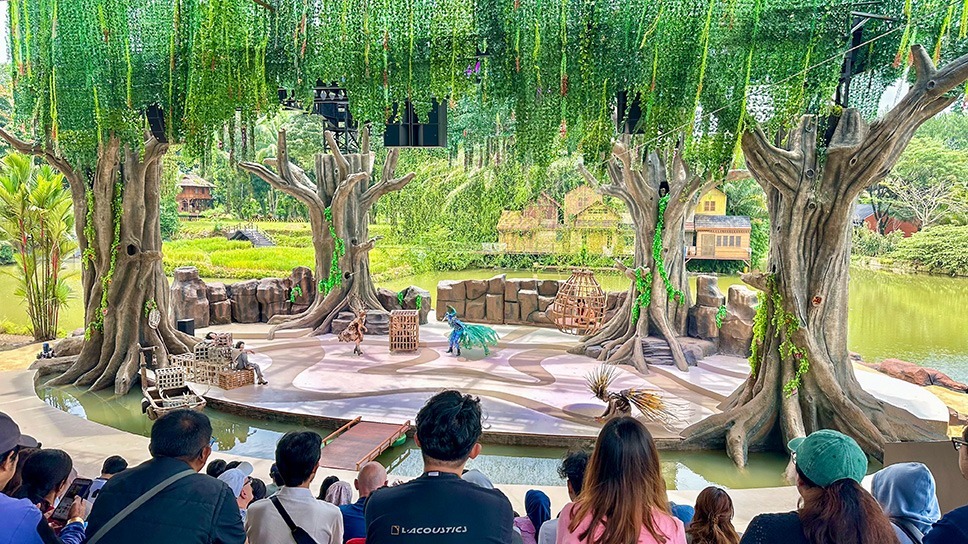
The 500-seat open-air theatre at Enchanting Valley hosts the daily musical “Lila Show”, reinforced by an L-Acoustics A Series sound system. (Image: L-Acoustics)
Outdoor audio and electrical safety
Water and electrical power are a particularly dangerous combination. At professional outdoor events, power distribution and earthing must therefore be planned by qualified specialists. A safe concept includes suitable residual-current protection devices, weather-resistant distribution units, mechanically protected cable routes and consistent protection against standing water. Clear load and phase planning, surge and lightning protection, defined shut-down procedures and regular electrical inspections are also required. The protection rating of an active loudspeaker is no substitute for a professionally designed power supply.
Why maintenance is particularly important in tropical climates
Even weather-resistant loudspeakers are not maintenance-free. High humidity, salt, dust, sand, plant debris and insects can accumulate on enclosures, grilles and connections over time. A maintenance schedule should therefore include regular visual inspections, corrosion checks and inspection of screws, brackets, seals and cable glands. Removing salt and dirt, checking connection panels and drainage, and carrying out functional tests on all signal paths and drivers are equally important. Cables and strain relief should also be inspected, and damage or repairs documented. In coastal regions, water parks and installations used every day, inspection intervals should be shorter than for seasonal systems installed under cover.
Checklist: Selecting outdoor loudspeakers for tropical climates
Before selecting a product, planners and operators should answer the following questions:
- Will the system be permanently or only temporarily installed outdoors?
- Is the location fully, partly or not at all covered?
- How frequently do heavy rain and strong winds occur?
- Is the system located close to the coast?
- What IP rating does the loudspeaker have?
- Under which mounting conditions does this protection rating apply?
- Are the connections and cables also protected?
- Are the grilles, screws and brackets corrosion-resistant?
- Is information available on UV, salt or humidity testing?
- What operating temperature range is permitted?
- Where will amplifiers and network components be installed?
- How accessible is the system for maintenance?
- Are local service and spare-parts partners available?
- What sound level, throw distance and directivity are required?
- Is a subwoofer required?
Outdoor audio at Prolight + Sound Bangkok
Prolight + Sound Bangkok is aimed at the entertainment, events and ProAV sectors in Southeast Asia. The announced programme includes outdoor audio demonstrations featuring modern line array systems. This gives trade visitors an opportunity to experience systems not only on exhibition stands but under more realistic operating conditions.
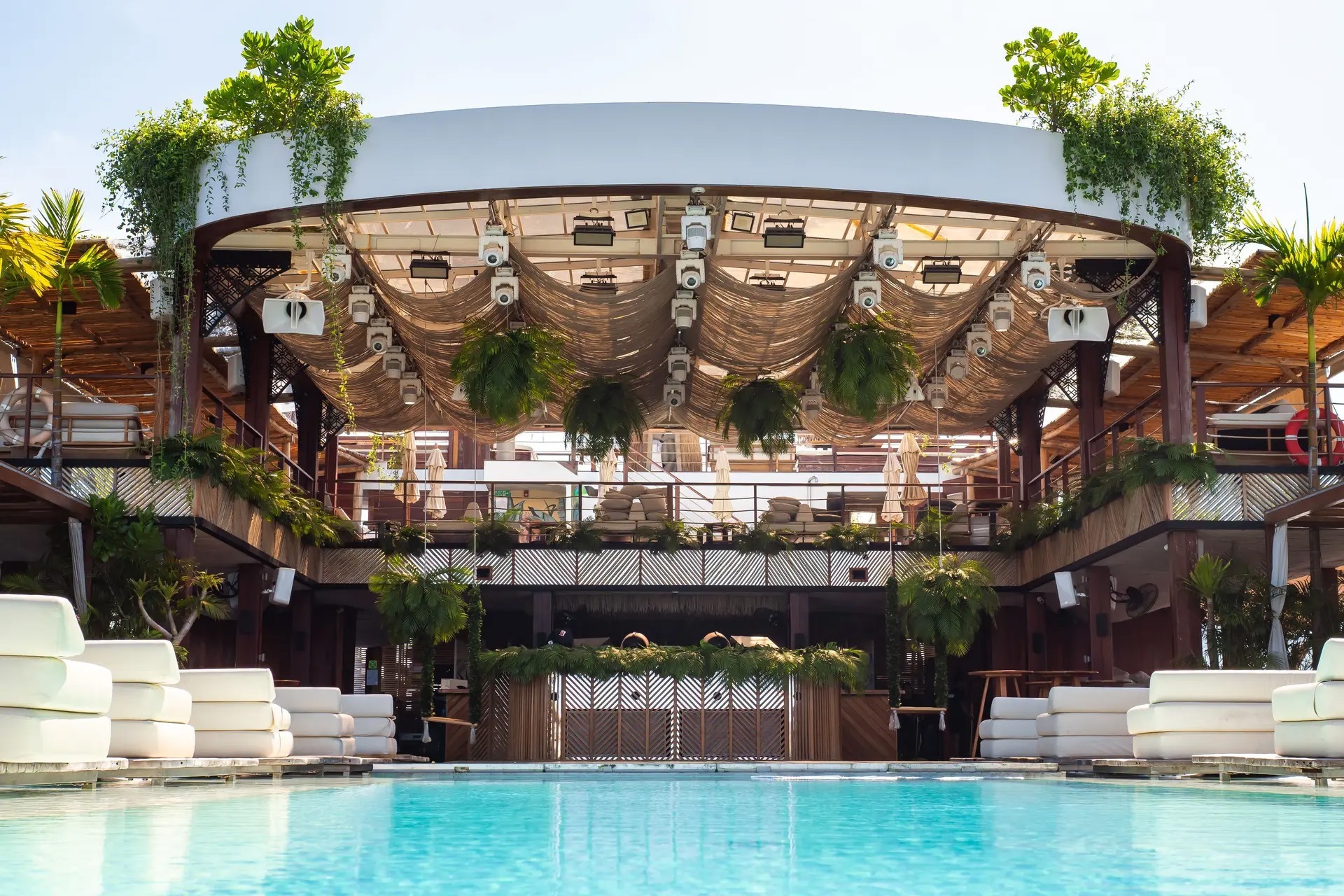
Weather-resistant loudspeakers provide even sound coverage around the pool at Yona Beach Club Phuket. (Image: Aura Visual System)
Tropical suitability is a property of the entire system
A good outdoor loudspeaker for tropical climates needs to do more than a conventional PA cabinet with rain protection. What is required is a complete system in which the enclosure, connections, cables, brackets, amplifiers and power distribution are all coordinated.
The IP rating provides an important first indication, but it must not be considered in isolation. Mounting method, corrosion resistance, UV protection, thermal management and regular maintenance are equally important.
The right solution always depends on the specific location. In tropical climates, the loudspeaker with the highest IP rating is not automatically the best choice. What matters is whether the acoustic, mechanical and electrical properties of the entire system match the application.
Hero image: 4iMEDIA / ChatGPT
Frequently asked questions about outdoor audio in tropical climates
What IP rating do outdoor loudspeakers require?
IP54 may be sufficient for protected outdoor areas. For permanently or regularly exposed systems, IP55 is often a more appropriate starting point. In highly exposed areas, water parks or locations with frequent heavy rain, IP56 can offer advantages.
Is IP55 sufficient for tropical rain?
IP55 protects against water jets but does not make a loudspeaker waterproof. Whether the rating is sufficient depends on the mounting position, rain intensity, wind, connections and any additional structural protection.
What is the difference between IP55 and IP56?
Both ratings provide dust protection. IP56 offers protection against more powerful water jets than IP55. The exact suitability still depends on the manufacturer’s specifications and the installation.
Are standard PA loudspeakers suitable for outdoor events?
Only where the manufacturer expressly permits outdoor use and suitable protective measures are in place. A standard loudspeaker without a specified weather rating should not be exposed unprotected to rain or high humidity.
Is a stage roof sufficient protection against rain?
Not always. Wind can drive rain underneath the roof from the side. Spray, condensation and water running along cables also remain possible risks.
Which loudspeakers are suitable for coastal regions?
Suitable systems use corrosion-resistant metal parts, sealed connections and preferably documented salt spray testing or dedicated marine versions. The IP rating alone is not a sufficient selection criterion.
Are active or passive loudspeakers better for tropical climates?
Both options can work. Active systems require weather-protected power and signal connections at the loudspeaker. With passive systems, the electronics can be installed in a protected technical room.
How can audio connections be protected against rain?
Manufacturer-approved outdoor connectors, protective caps, cable glands and UV-resistant cables should be used. Drip loops prevent water from running directly along the cable into the connector.
Do weather-resistant loudspeakers still need to be covered?
Where structurally possible, additional cover will generally extend service life. It reduces direct exposure to rain, sunlight and dirt, but does not replace a suitable protection rating.
How often should outdoor loudspeakers be serviced?
This depends on the location and pattern of use. Systems in coastal regions, water parks or permanently humid environments should be inspected more frequently than seasonal systems installed under a roof. Particular attention should be paid to corrosion, brackets, seals and connections.